Village Entrances:
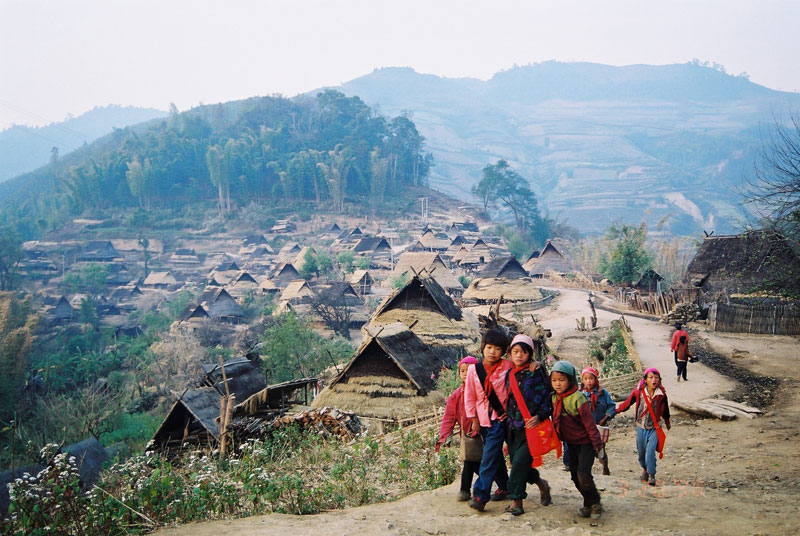
 A Wa village located in Menglai Township, Cangyuan County, Yunnan Province. It is consisted of over one hundred ganlan-style straw huts built close to each other. The small hill located in the distance and covered with bamboo and trees is this village’s “divine forest.” (Photographed by author in 1998.) Fan Guo-Yu’s records show that the Wa people “live together in villages designed with a gate situated on the main path two or three kilometers into the village. The gate is built of two erected logs with four or five holes, and another log is placed horizontally across the vertical logs to create a barrier. …This gate is built to defend the village, and some villages have several such gates within a distance of one or two kilometers from each other.”19Fang Guo-Yu (1943) Dianxi bianqu kaochaji, p. 31. Also see Rui Yi-Fu (1972) Short Essay on Four Ethnic Groups on the Yunnan-Burma Border, Discourse on Chinese Nationality and Culture, p.393. Taipei: Yiwen Publishing. In the past, the gate to a Wa village was always very intricately designed. It usually had a very narrow entrance, and prickly plants such as yellow rattan were planted around it to keep away outsiders and wild animals. Compared to the other ethnic minority groups nearby, the Wa people have larger and stronger village units, which can be inferred from the design of their village gates.
Clothing and Accessories:
 Traditional Wa clothing and accessories found in the Ximeng region. (Photographed by author in 2001.) The styles and designs of Wa traditional costumes and accessories vary widely from region to region. In the Yanshuai region of Cangyuan County, the tradition costume for Wa men is consisted of “a black head wrap, short, round-collared black shirt, and short, wide black pants. They are often armed with spears, bow and arrows, or a long knife.”20Chronicle of Yunnan Province Cangyuan Va Nationality Autonomous County Editing Committee, ed. (1998) Chronicle of Yunnan Province Cangyuan Wa Nationality Autonomous County, p. 80. In the Banhong region of Cangyuan County, the traditional costume for Wa men “is identical to that of the Baiyi (Dai) people and the Lisu people—short shirt and long pants made of blue fabric, and white or blue head wrap… When they go out, they would carry a long knife, a cloth bag, and hang a smoking pipe at their waist.”21Fang Guo-Yu (1943) Dianxi bianqu kaochaji, p. 36. Also see Chronicle of Yunnan Province Cangyuan Wa Nationality Autonomous County Editing Committee, ed. (1998) Chronicle of Yunnan Province Cangyuan Wa Nationality Autonomous County, p. 80. The traditional styles of dress for Wa women are more diverse than the men’s. The basic pattern is a combination of red and black stripes; in the Yanshuai region, the traditional women’s costume is a black, round-collared shirt decorated with small silver ornaments, and a skirt with red and black stripes. In recent years, in addition to red and black, a combination of yellow and blue has become acceptable as well. “The elderly women like to wear silver ear plugs or hoop earrings, and some wear strings of white beads around their neck or waist…Their arms and wrists are donned with an assortment of bangles, and several bamboo hoops circle their thighs and calves.” The traditional costume for Wa women in the Banhong region is influenced by Dai culture—“The women dress like the Baiyi (Dai), in mostly dark blue clothing… Their earrings are no lighter than three or four liang.”23Fang Guo-Yu (1943) Dianxi bianqu kaochaji, p. 36.
|