The regions inhabited by people of Wa nationality are often known collectively as “Mt. Awa” (other names include “Mt. Kawa” and “Land of the Hulu Gourd Kings”). Existing documents give at least two different descriptions on the area of this “Mt. Awa.”
First, according to Fang Guo-Yu’s Field Investigation Record of Western Yunnan Borders, Mt. Awa refers to “the surrounding areas of Shunning in southwestern Yunnan, i.e. the region that is south of today’s Mengding and north of the lower reaches of Nanka River, and stretches eastward to Genma, Mengjiao, and Dongmu (making it part of districts which were governed by Menglian chieftains), and is separated from Mubang and Dongjing in the west by Lu River.” This record also states that “the region’s inhabitants are called ‘Kawa,’ hence one other name of their territory ‘Mt. Kawa,’ which is also called ‘Land of the Hulu Gourd Kings.’”6
Fang Guo-Yu (1943) Dianxi bianqu kaochaji, p. 3.
In the 1940s, the national boundary between Burma and China had not yet been clearly decided upon, and therefore Fang Guo-Yu’s description of Mt. Awa—which was located next to Burma—was based on the boundaries of the local administrative areas. He named the Wa region, then reigned by Dai chieftains, after the hulu gourd, a symbolic object in Wa people’s myths of creation, calling the area ruled by several Wa kings “Land of the Hulu Gourd Kings.”
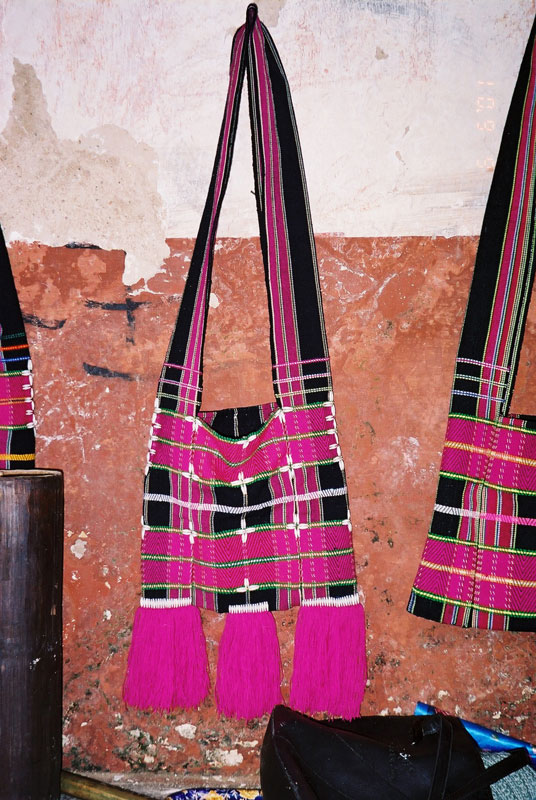
A cloth bag from Ximeng with horizontal stripes, woven with black and pink yarn and decorated with cross patterns of white coix millet seeds. (Photo taken by the author in 2001.)
The name “Kawa” was commonly used in early Chinese historical documents; at the time non-Wa peoples used this term to refer to the Wa people, regardless of the fact that the word ka in “Kawa” had been borrowed from the Dai language and meant “slave.” By the 1930s, the name “Kawa” was already considered offensive by many Wa people. As Fang describes, “Those who called them ‘Kawa’ were cursed at severely.”7
Fang Guo-Yu (1943) Dianxi bianqu kaochaji, p. 5.
It was not until the year 1956 that government bureaus officially denounced the use of the word “Kawa” out of respect for Wa people, and with the help of nationality classification project, officially recognized this ethnic group as “Wazu.”8
Ruo Zhi-Ji (1995) Wa Society, History, and Culture, p.63-64.
Second, a more contemporary saying concerning “Mt. Awa” claims that from east to west it ranges from Lancang River (which goes by the name of Mekong River when it flows through Thailand, Laos, and Vietnam) to Nu River (which is known as Salween River in Burma); while due to the issue of an unclear national border, there is no absolute answer to its southern and northern boundaries. The geographical distribution of the Wa people range between 22°27”N and 22°56”N, and 99°18”E and 99°43”E; this area is also called “Mt. Awa.”
Mt. Awa is, as the name implies, a mountainous region, with altitudes ranging between 500 to 2,700 meters. This type of landscape makes it extremely difficult for Wa villagers to keep in touch with the rest of the world. It usually takes two to five hours for the Wa inhabitants of mountainous regions to get to the little bazaar that is held every five days, where they would sell tea, bananas, tapioca, wild fruits and vegetables, tobacco, and tree vines and use their proceeds to buy daily necessities such as salt, chili peppers, MSG, sesame oil, and hand rolled cigars. These bazaars are mainly located where the local township government is. In the past, Wa women would use the period between December and the following April, when there was little farm work, to make white thread from tree bark or cotton, which they would dye and weave into fabric to make traditional clothing and accessories. Most women worked on the lower level of their ganlan-style houses, next to the pigs and cows. However, due to the decrease in cotton production and relatively cheaper prices of ready-made clothing on the market, fewer and fewer Wa women still weave their own cloth.
The Wa is an ethnic minority group that populates both sides of the China-Myanmar border. The number of Wa people living in northeastern Myanmar’s Wa State far exceeds the total number of Wa people in China. According to the Chinese government’s official census, as of December 2003 there were 136,116 Wa people living in Cangyuan County, Yunnan Province.9
Chen Rong-Hua, ed. (2004) Zhuei zhu tai yang de awa shan [The Sun-Chasing Mt. Awa], p. 2.
Along with the 59,830 people of Wa people in Ximeng County, and the rest of the Wa population scattered elsewhere in China, the total population of Wa people in China added up to approximately 400,000 people,10
Zhou Zhi-Zhi, Yan Qi-Xiang, Chen Guo-Qing (2004) Research on Va Dialects.
while the number of Wa people in Myanmar’s Wa State alone surpasses 600,000. The official numbers published by the government are possibly much smaller than the actual numbers of Wa people residing in China or Myanmar because official numbers are usually based on the number of people who have registered with the government, and it is not uncommon to find people in Mt. Awa who have not done so.
The region inhabited by Wa people in Myanmar is often not referred to as “Mt. Awa,” but the administrative unit “Wa State” instead. However, although the official map provided by the government of Myanmar shows that Wa State lies between 22°56”N and 23°N, and 99°E and 100°E, this region is also included within the boundaries of Myanmar and belongs to the country’s Second Special District of Shan State.11
Bertil Lintner (1999) Burma in Revolt: Opium and Insurgency Since 1948.
In reality, Wa State is a semi-independent autonomous region controlled by the United Wa State Army (UWSA) led by Bao You-Xiang, a Yunnan-born man of Wa nationality. In other words, the Myanmar government does not have the direct political authority to rule this region. The Wa people in Myanmar are often associated with drugs in the public media. This area grabbed the attention of the United Nations International Drug Control Programme (UNIDCP) for its long history of poppy cultivating, but with financial aid contributed by the global community, many anti-drugs campaigns have been carried out in Wa State. However, military conflicts are still common in this region due to ethnic clashes and a difference in attitude regarding the handling of drug issues between the Wa people and their neighbors the Shan and Thai troops.